Follow us live on BBC radio 3

BBC Celtic Connections


Mary Ann Kennedy live from Glasgow at one of the world’s biggest winter music festivals, with special late-night performances from the CCA, the BBC’s hub on Sauchiehall Street.

On the line-up tonight is one of world music’s classic bands, Taraf de Haidouks, who for 25 years have taken the energy and intensity of Romanian gipsy music to the world; Songhoy Blues, a young desert blues punk band from Timbuktu in Mali; and Canzoniere Grecanico Salentino from southern Italy, one of the country’s oldest folk bands but now in its second generation, refreshing the songs and dances of Puglia’s pizzica and tarantella traditions.

Celtic Connections is held in 20 venues over 18 days with 300 events taking place throughout the whole festival, involving over two thousand musicians from 26 countries. Scots and Irish Celtic music is at the centre of the festival, but it has always embraced the music of the Celtic cultures of the USA, Canada, France and Spain, together with the closely connected cultures of Scandinavia and eastern Europe. In recent years the Festival has also connected with traditions across Africa and Asia. The concerts range from the most traditional to the most experimental, all brought together in the context of one of the world’s liveliest folk cultures, with a never-ending stream of young Scottish musicians who are reinventing their own traditions for their own time.

This is the second of two live late-night sessions from Glasgow’s Centre for Contemporary Arts, each featuring some of the best acts from the Festival. It is part of BBC Music’s extensive coverage of Celtic Connections, also featuring on BBC Radio 2, BBC Radio Scotland, BBC2 TV in Scotland, and BBC Music Online.

Tickets available from the BBC Tickets website from Friday 16th January.


Canzoniere Grecanico Salentino: A Whirlwind of Mastery

Canzoniere Grecanico Salentino: A Whirlwind of Mastery

Review by Lily Allen-Duenas

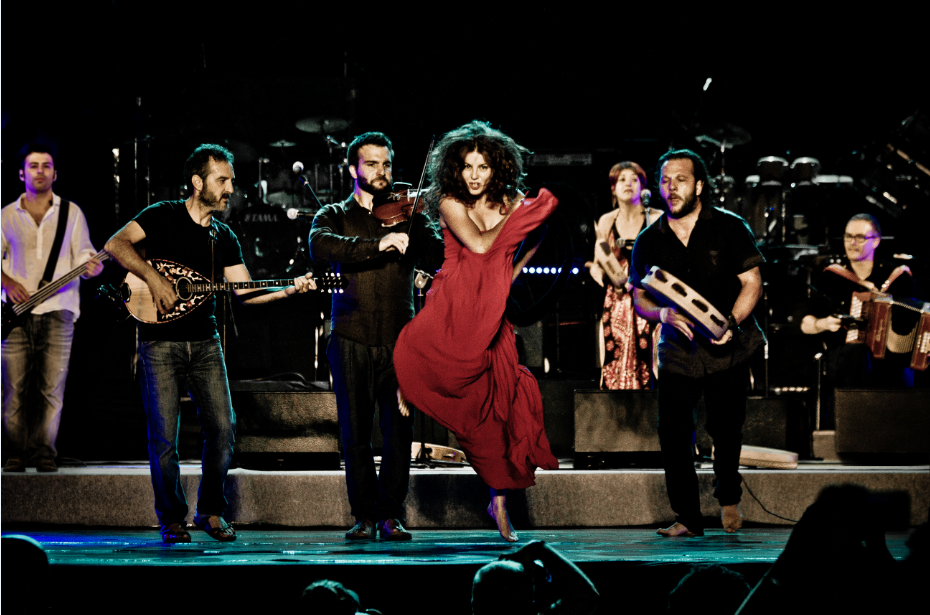
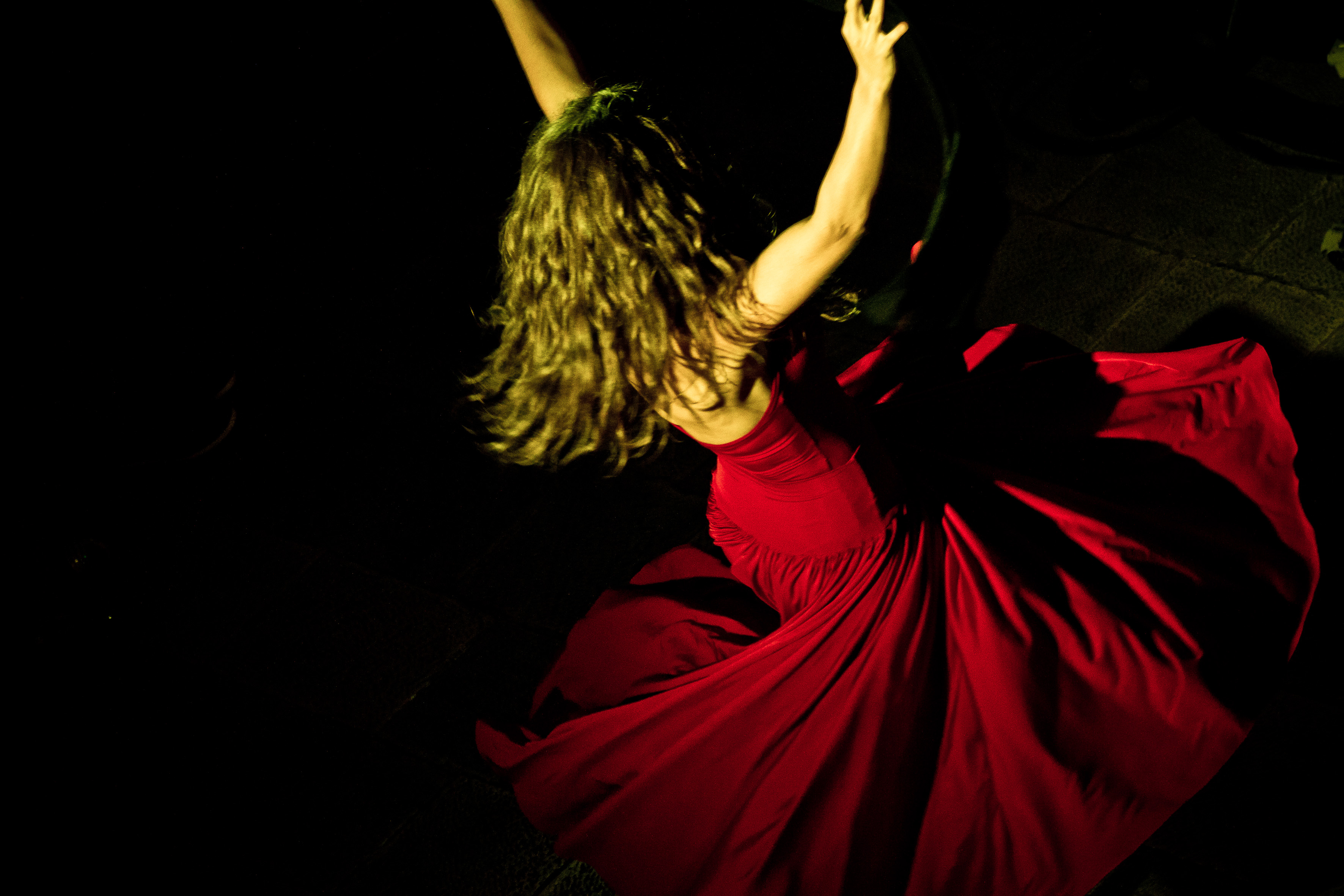
Canzoniere Grecanico Salentino slowly entered the stage, one by one, adding one instrument at a time to the rising music, until it was a forceful flurry of interwoven rhythm and sound. It was completely hypnotic. The forceful striking of the hand drum, the clash on the tambourine, the quick breaths of the accordion, the excited thrum of the bass, all formed a netlike entity that wrapped itself around the packed room. And then the dancer entered the stage. Garbed entirely in white, the dancer, Silvia Perrone, whirled and twirled with pursed lips, bare feet, and bright eyes, waving a white scarf with quick hands. She, and the rest of the band, were mesmerizing.

The 7th annual Landfall Festival of World Music began with a bang at CSPS on Tuesday, September 16 with Canzoniere Grecanico Salentino, a group of six musicians plus a dancer from Southern Italy. (If you think of Italy as a boot, they are from the heel.) Canzoniere Grecanico Salentino is a multi-generational band that is celebrating its 40th year together, and was formed by the parents of some of the current band members. Canzoniere Grecanico Salentino was a part of Cedar Rapid’s Landfall Festival three years ago, so this wasn’t their first time in Iowa, Cedar Rapid’s, nor at CSPS.

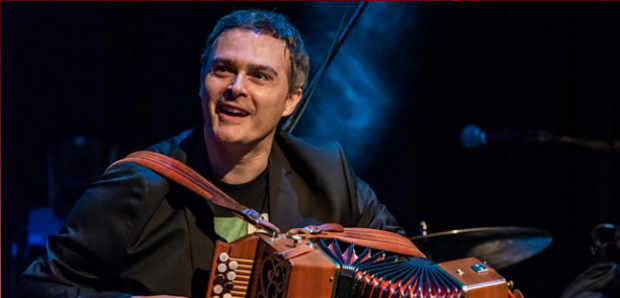
Their members include: Mauro Durante on the frame drums, violin, and vocals, Giulio Bianco on the zampogna, armonica a bocca, recorders, Emanuele Licci on the guitar, bouzouki, and vocals, Maria Mazzotta on the tamburello Massimiliano Morabito, diatonic accordion, and vocals, and Giancarlo Paglialunga on the vox, tamburello, with Silvia Perrone as the dancer. Canzoniere Grecanico Salentino gives meaning to the words multi-instrumental musicians.

They all sang in Greco, also called Grecanico, a dialect from their region of Italy that linguists fear is dying. Canzoniere Grecanico Salentino plans and hopes to keep the language alive with their vast songbook. Mauro Durante briefly translated the meaning of each song before they performed it, but the underlying message in each song was clear through the rhythms and through the expressive lead singer, Maria Mazzotta, whose piercing soprano voice had an intensely spiritual tone as if every note venerated the audience. Most impressive was Giancarlo Paglialunga’s rapid-fire percussive magic on the tamburello, maintaining a fiercely fast rhythm that required his hands blur with the swift movement, was nothing short of a fantastical feat. Also, Mauro Durante played a song solo using nothing but the frame drum, which he masterfully manipulated to create almost the entire range of sound a drum-kit would create.

Canzoniere Grecanico Salentino didn’t tolerate a single moment of mediocre. They packed as much into a moment as possible, filling every second to the brim with an amalgam of masterful sounds.
If Canzoniere Grecanico Salentino’s show says anything about the Landfall Festival it is that you must go, you simply must go. Such exquisitely skillful music bursting with life and talent and passion should never be missed.

READ THE ARTICLE

The Irish Independent : The whirling rhythms and gale force of CGS aresomething to behold

Folk Canzoniere Grecanico Salentino Button Factory, Dublin

Ed Power


The whirling rhythms and gale force irascibility of Canzoniere Grecanico Salentino are something to behold. Violins shriek and swoon, an accordion groans, a bass guitar throbs and thuds dissonantly. Sometimes vocals will intrude, rising like a wind over the tumult of instrumentation.

The Italian band are part of a Continent-wide folk revival which seeks to look past tourist clichés and present ancient sounds in a modern context. However, a deep knowledge of the compositional traditions of rustic Europe is not a prerequisite to enjoying their music. They are fast, they are relentless  – and, for the newcomer, that is enough. No expertise is necessary – merely an ability to appreciate a cracking tune conveyed at breakneck pelt.

That said, their brand of Italian folk has a deep history: the Salento region in the country’s ‘boot heel’ stands at a crossroads between the Eastern Adriatic and Africa, and, as the fancy takes, Canzoniere Grecanico Salentino are able to inhabit both worlds. One moment there’s a dervish intensity that reminds you of the aching Saharan pulsations of Tinariwen, elsewhere the pre-modern cacophony puts the listener in mind of the neo-medieval experimentation of Dead Can Dance. It’s gorgeous – yet deeply eerie when it wants to be.

Given Dublin’s large Italian population, it is no surprise ex -pats should be out in strength – or that, as dancer Silvia Perone emerges, red caped and shoeless, many in the audience mirror her gestures, holding scarves about their heads in the traditional fashion as they sway back and forth (good luck squeezing past with a clutch of beers in hand).

At the risk of showcasing one’s ignorance, it might be pointed out that great swathes of European folk music can sound like Irish trad played at slightly the wrong speed. This is certainly true here: with band leader Mauro Durante’s violin taking the lead, the seven-piece plunge into the sort of whirligig fugue familiar to anyone who sat through Ceili House as a youngster..

Only when the music stops, do the cheesier elements of Canzoniere Grecanico Salentino’s identity shine. Speaking slowly Durante explains that the folk forms his ensemble extol have their roots in celebratory dance – those ancient traditions may have fallen away but the truth of their message endures. Life is short, seize the moment while you can. It’s a cornball sentiment, one that Durante and his players articulate with tremendous fervour.

Irish Independent

15/08/2014

READ THE ARTICLE

The Times : Past and present, east and west, were always in harmony

10827908_10155113385755055_1243630552288350991_oCanzoniere Grecanico Salentino at the Queen Elizabeth Hall

Published at 12:01AM, August 5 2014

The weather forecast had not been promising, so we scanned the skies, wondering if the rain would stay away. Open to the elements, the greenery not quite masking the outcrops of brutalist concrete, the QEH’s roof garden would have made a less than Mediterranean setting if the heavens had opened. But in the end, the British summer held firm, and the only distractions came from noises off: trains on Hungerford Bridge, the clatter of a police helicopter, the metronomic thump of a disco boat on the Thames

Mauro Durante and his six colleagues took it all in their stride. (…)

Read the full article about CGS

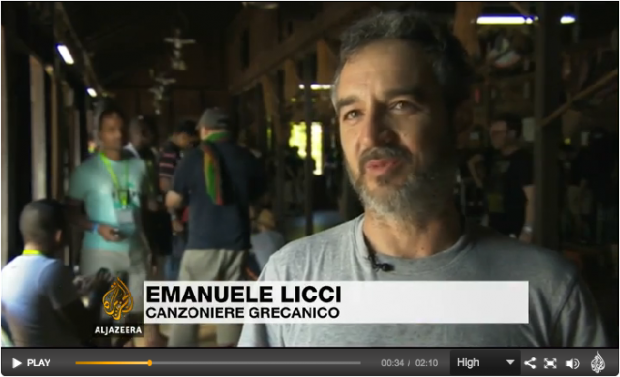
Jamela Alindogan, Al Jazeera’s reporter, interview Emanuele Licci

Malaysia festival

Thousands gather in Sarawak for a festival that celebrates indigenous musicians and their cultural heritage. Thousands of people are gathering in eastern Malaysia for a music festival celebrating indigenous musicians from around the world. More than 100 musicians will peform at the festival in Sarawak, which organisers say has helped tourism and helped rebuild the region’s identity.

Al Jazeera’s Jamela Alindogan reports from Sarawak.